


 PLATFORM UPDATE:

Grafting polymer brushes from nylon surfaces via hydrogen atom transfer
 a
Julianna R.
Koehl,
ac
Christopher K.
Ober,
b
Yadong
Wang,
c
Geoffrey W.
Coates
*a
and
Brett P.
Fors
*a
a
Julianna R.
Koehl,
ac
Christopher K.
Ober,
b
Yadong
Wang,
c
Geoffrey W.
Coates
*a
and
Brett P.
Fors
*a
Abstract
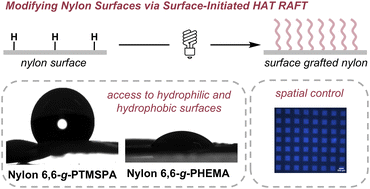
The direct functionalization of nylon surfaces with well-defined polymer brushes would enable access to functional materials for advanced biomedical and industrial applications. To this end, we developed a surface-initiated hydrogen atom transfer reversible addition–fragmentation chain-transfer (SI HAT-RAFT) polymerization to directly graft from nylon surfaces under mild conditions. Hydrogen abstraction by a triplet-excited thioxanthone catalyst initiates polymer chains, which are capped by a bistrithiocarbonate moiety. Our method is amenable to (meth)acrylic and acrylamide monomers and various commercially relevant nylon substrates, and we demonstrate spatial control over the polymerization by patterning nylon surfaces with polymer brushes. Finally, we explored the ability of our method to modify surface properties by measuring water contact angles with select polymer grafts and demonstrate that hydrophilic polymer brush modifications inhibit bovine serum albumin adsorption.
 Please wait while we load your content...


