


 PLATFORM UPDATE:


Aromatic phosphonate-based luminophores: universal building blocks for ultralong room-temperature phosphorescence and multifunctional applications

Abstract
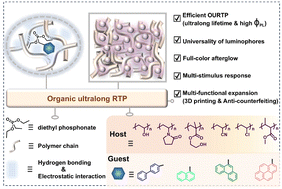
The construction of organic ultralong room-temperature phosphorescence (OURTP) materials with high photoluminescence quantum yield and long lifetime is significant but challenging. Non-radiative transition caused by excessive molecular aggregation and vibrational relaxation usually suppresses phosphorescence of polycyclic aromatic hydrocarbons (PAHs) under ambient conditions. Herein, functionalization of PAHs with diethyl phosphonate has been proven effective in achieving full-color OURTP with stimulus-responsive properties in various polymers. The introduction of hydrophilic substituents significantly inhibits excessive molecular aggregation and phase separation between the host and guest. Non-covalent interactions such as hydrogen bonding and electrostatic interaction can enhance environmental rigidity and hinder vibrational relaxation. The synergistic effect of these interactions greatly suppresses non-radiative transition, unlocking efficient OURTP with long lifetime and high photoluminescence quantum yield of 2.05 s and 41.7% in different doped systems, respectively. Meanwhile, aromatic phosphonate-based luminophores can be uniformly dispersed in the host by switching different hydrophilic and hydrophobic polymers. The extraordinary luminescence performance of the doped systems outperforms other substituents, demonstrating the effectiveness and versatility of diethyl phosphonate functionalization. Furthermore, benefiting from the multi-stimulus response and full-color afterglow of the doped systems, potential applications in anti-counterfeiting, dynamic pattern visualization and 3D printing are explored, providing novel perspectives for the construction and application in OURTP materials.
- This article is part of the themed collections: Joint collection on photoluminescent organic materials and 2026 Chemical Science HOT Article Collection
 Please wait while we load your content...


