


 PLATFORM UPDATE:


Evidence of static quenching in the photoredox activity of perylene diimide radical anions: implications for consecutive photoinduced electron transfer photocatalysis

Abstract
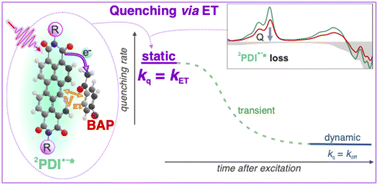
The radical anions of perylene diimides (PDI˙−*) are increasingly used photocatalysts in consecutive photoinduced electron transfer (conPET) for aryl-halide reduction. Despite this, the mechanism behind this reduction by PDI˙−* remains unclear since no dynamic quenching was observed for aryl halides. Here, we combine stationary and ultrafast transient absorption spectroscopy from the UV to the near IR to reinvestigate the photoreactivity of PDI˙− in the presence of bromoacetophenone (BAP). Independently of the method used to generate PDI˙−, the solvent, and the excitation wavelength, a prompt decrease of the excited-state population without any change in lifetime is observed upon addition of BAP. This effect coincides with a similar decrease of the stationary fluorescence intensity of PDI˙−, pointing to the occurrence of static quenching by BAP. As no photoproduct is detected, this static quenching is associated with a sub-100 fs photoinduced electron transfer, followed by ultrafast recombination by back electron transfer. It does not involve any pre-association of the reactants in the ground state but is simply due to the significant probability of a BAP molecule to be at an adequate distance and orientation relative to PDI˙−* for electron transfer to occur without diffusion. Using molecular dynamics simulations, we show that such condition is easily fulfilled at high quencher concentrations. Despite this, the overall quantum yield of the conPET mechanism is vanishingly small, because of several fundamental limitations related to the two photoinduced electron transfer steps and to the use of organic radical ions as photocatalysts.
 Please wait while we load your content...


