Promoting effect of nickel-chromium hydroxide on nickel phosphide nanosheets for efficient hydrogen production coupled with sulfion degradation

Abstract

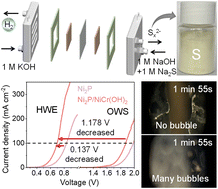
Electrochemical hydrogen production represents a sustainable approach for hydrogen generation. However, its large-scale practical application is largely limited by the sluggish oxygen evolution reaction (OER). In this study, the thermodynamically favorable sulfion oxidation reaction (SOR) is employed to replace slow OER and nickel phosphide/nickel-chromium hydroxide (Ni2P/NiCr(OH)2) nanosheets are constructed to achieve low-energy hydrogen production. Benefiting from the interfacial water structure reorganization and electronic structure optimization caused by NiCr(OH)2) introduction, and uniform nanosheet morphology, Ni2P/NiCr(OH)2 can achieve a current density of 10 mA cm-2 at low overpotentials for both hydrogen evolution reaction and SOR. The assembled hybrid water electrolyzer requires small voltages of 0.513 and 0.698 V to reach 10 and 100 mA cm-2, significantly lower than those of conventional water electrolysis. Moreover, Ni2P/NiCr(OH)2 exhibits excellent stability for 800 h at 200 mA cm-2 and realizes the conversion of sulfion into valuable elemental sulfur. This work presents a promising strategy for achieving energy-efficient hydrogen generation and resource utilization of sulfide-containing pollutants.
Supplementary files

Transparent peer review

To support increased transparency, we offer authors the option to publish the peer review history alongside their article.

View this article’s peer review history

Article information

Article type
Edge Article
Submitted
20 Mar 2026
Accepted
28 Apr 2026
First published
29 Apr 2026
This article is Open Access

All publication charges for this article have been paid for by the Royal Society of Chemistry
Creative Commons BY-NC license

Chem. Sci., 2026, Accepted Manuscript

Promoting effect of nickel-chromium hydroxide on nickel phosphide nanosheets for efficient hydrogen production coupled with sulfion degradation

X. Wang, J. Li, X. Zhu, Z. Xu, S. Xie, S. Chen, Y. Wan, G. Zhang, M. Ge, W. Zhang, C. Wang and R. Li, Chem. Sci., 2026, Accepted Manuscript , DOI: 10.1039/D6SC02309F

This article is licensed under a Creative Commons Attribution-NonCommercial 3.0 Unported Licence. You can use material from this article in other publications, without requesting further permission from the RSC, provided that the correct acknowledgement is given and it is not used for commercial purposes.

To request permission to reproduce material from this article in a commercial publication, please go to the Copyright Clearance Center request page.

If you are an author contributing to an RSC publication, you do not need to request permission provided correct acknowledgement is given.

If you are the author of this article, you do not need to request permission to reproduce figures and diagrams provided correct acknowledgement is given. If you want to reproduce the whole article in a third-party commercial publication (excluding your thesis/dissertation for which permission is not required) please go to the Copyright Clearance Center request page.

Read more about how to correctly acknowledge RSC content.

Social activity

Spotlight

Advertisements