


 PLATFORM UPDATE:


A robotic approach to polymerisation kinetics: a case study on copolymerisation parameter estimation
 †a
and
Tanja
Junkers
*a
†a
and
Tanja
Junkers
*a
Abstract
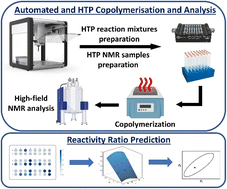
Automation and high-throughput (HTP) experimentation are transforming chemistry, yet the high cost of robotic platforms limits accessibility. Pipetting robots such as the Opentrons OT-2 provide a cost-effective, open-source alternative, but their application to radical polymerisation in high throughput formats has been restricted by challenges such as deoxygenation at microlitre scale. Here, we establish a robust workflow for thermal radical polymerisation in a 48-well reactor using the OT-2, supported by custom 3D-printed components for automated NMR sample preparation. This system enables rapid and reproducible data generation while eliminating human bias from experimentation. We demonstrate its utility through the study of copolymerisation kinetics, where inconsistent methods, reporting, and model selection have created significant data gaps for predictive modelling. By combining robotic HTP experimentation with IUPAC-recommended evaluation methodology, we provide standardised datasets for predicting reactivity ratios of six monomer pairs: BMA-BA (r1 = 2.22, r2 = 0.37), BMA-St (r1 = 0.58, r2 = 0.73), St-BA (r1 = 1.23, r2 = 0.32), St-MMA (r1 = 0.46, r2 = 0.58), GMA-BA (r1 = 1.77, r2 = 0.24), and GMA-St (r1 = 0.69, r2 = 0.32). Each dataset can be generated and analysed within hours, offering a powerful automated platform for systematic polymerisation studies. This work establishes the OT-2 as a practical, accessible tool for accelerating polymer research and enabling data-driven chemical discovery.
 Please wait while we load your content...


