


 PLATFORM UPDATE:

Goldilocks boronic esters: optimized properties through understanding hydrolysis kinetics
 a
Samantha S.
Cox,
a
Yuecheng
Jiang,
a
Ivan J.
Yuan,
a
Margaret A.
Hankins
a
and
Zachary T.
Ball
*a
a
Samantha S.
Cox,
a
Yuecheng
Jiang,
a
Ivan J.
Yuan,
a
Margaret A.
Hankins
a
and
Zachary T.
Ball
*a
Abstract
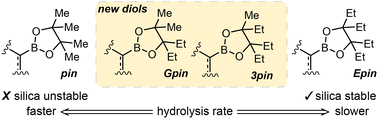
Boronic acids react reversibly with diols to form boronic ester derivatives, a process that can be used as a protecting group in multistep synthesis. Boronic ester formation is also an example of dynamic covalent chemistry that can be used for diverse applications, including polyol recognition, dynamic soft materials, and controlled drug release. Somewhat surprisingly, only limited quantitative structure–function relationships for boronic stability with different diols are available, with the consequence that it has been difficult to choose or design optimal reactivity, whether for multistep synthesis or for dynamic covalent applications. Here we report the first systematic study of a family of 1,2-diols that enable a series of boronic esters with tunable hydrolytic behavior and simple one-pot formation. Across a panel of aryl, heteroaryl, and bioactive boronic acids, we found that diol structure, electronics, and pH can be used together to modulate hydrolysis rates over a broad range while maintaining silica compatibility. This work establishes a practical dataset for rationally selecting boronic ester protecting groups to achieve predictable, mild, and temporally controlled access to free boronic acids in water under biocompatible conditions, and also provides a simple synthetic solution to some longstanding challenges in the preparation of complex boronic acids.
 Please wait while we load your content...


