Lewis base-mediated stabilization of the lattice oxygen mechanism in RuO2 for robust acidic water oxidation

Abstract

Stabilizing the lattice oxygen oxidation mechanism (LOM) pathway of Ru-based oxygen evolution reaction (OER) electrocatalysts under acidic conditions is pivotal for efficient proton exchange membrane (PEM) water electrolysis. Herein, we propose a Lewis base regulation strategy by introducing In into RuO2 to activate and stabilize the LOM process during the OER. Integrated in situ and ex situ characterization studies and theoretical calculations reveal that the In acts as an electron donor to modulate the interfacial water structure and accelerate deprotonation, thereby ensuring a continuous supply of *OH. Furthermore, In doping optimizes the electronic structure to promote *OH adsorption on Ru sites, enhance the Ru–O covalency, and stabilize oxygen vacancies generated during the LOM process, thereby synergistically improving both the activity and stability of the Ru-based catalyst along the LOM pathway. Benefiting from this Lewis base modulation, In-RuO2 exhibits outstanding acidic OER performance, achieving 10 mA cm−2 at an overpotential of only 194 mV with excellent stability (>1000 h). Furthermore, In-RuO2 outperforms RuO2 in PEM electrolyzer tests, operating stably for over 1000 h at 1 A cm−2. This work offers a design principle for highly active and stable LOM catalysts toward scalable green hydrogen production.
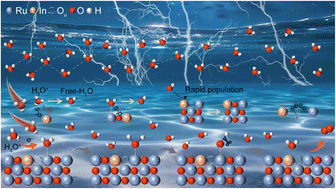
Graphical abstract: Lewis base-mediated stabilization of the lattice oxygen mechanism in RuO2 for robust acidic water oxidation

Supplementary files

Article information

Article type
Edge Article
Submitted
03 Mar 2026
Accepted
09 Apr 2026
First published
17 Apr 2026
This article is Open Access

All publication charges for this article have been paid for by the Royal Society of Chemistry
Creative Commons BY-NC license

Chem. Sci., 2026, Advance Article

Lewis base-mediated stabilization of the lattice oxygen mechanism in RuO2 for robust acidic water oxidation

S. Hu, S. Luo, H. Du, X. Zeng, J. Yang, X. Wang, H. Bao and N. Yao, Chem. Sci., 2026, Advance Article , DOI: 10.1039/D6SC01794K

This article is licensed under a Creative Commons Attribution-NonCommercial 3.0 Unported Licence. You can use material from this article in other publications, without requesting further permission from the RSC, provided that the correct acknowledgement is given and it is not used for commercial purposes.

To request permission to reproduce material from this article in a commercial publication, please go to the Copyright Clearance Center request page.

If you are an author contributing to an RSC publication, you do not need to request permission provided correct acknowledgement is given.

If you are the author of this article, you do not need to request permission to reproduce figures and diagrams provided correct acknowledgement is given. If you want to reproduce the whole article in a third-party commercial publication (excluding your thesis/dissertation for which permission is not required) please go to the Copyright Clearance Center request page.

Read more about how to correctly acknowledge RSC content.

Social activity

Spotlight

Advertisements