


 PLATFORM UPDATE:

Electron-injection-induced global aromaticity enables stable open-shell nanopillars with intense mid-infrared magnetic circular dichroism

Abstract
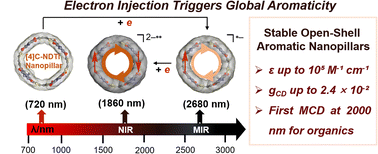
Open-shell species are central to spintronics and infrared optoelectronics, but remain challenging to stabilize in discrete molecular systems. Herein, we report that electron injection into pillar-shaped, radially π-conjugated [4]cyclonaphthodithiophene diimides ([4]C-NDTIs) triggers global aromaticity, yielding radical species with notable stability and optical properties. These globally aromatic radicals exhibit record-high mid-infrared (MIR) absorption (ε up to 105 M−1 cm−1), strong near-infrared (NIR) chiroptical activity (gCD up to 2.4 × 10⁻²), and exhibit MIR magnetic circular dichroism (MCD) with gMCD up to 5.0 × 10⁻³ T−1. In solution, the radical monoanion exhibits superior kinetic stability (τ1/2 = 4.3 days) compared to the diradical dianion (τ1/2 = 1.5 days), revealing a balance between aromatic stabilization and charge destabilization. These properties persist even upon C60 encapsulation, underscoring the robustness of the aromaticity-based design. This work establishes electron-injection-induced global aromaticity as a general strategy for stabilizing open-shell species while unlocking long-wavelength chiroptical and magneto-optical functionalities.
 Please wait while we load your content...


