


 PLATFORM UPDATE:


Design of permeability-optimized target-binding macrocycles via direct preference optimization

Abstract
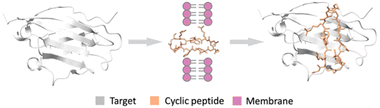
Macrocyclic peptides represent a promising therapeutic modality for challenging targets, such as protein–protein interactions. However, their clinical utility is often limited by inadequate membrane permeability, which restricts both intracellular target access and oral bioavailability. Existing structure-based generative methods for cyclic peptide design prioritize structural validity and binding affinity, yet lack mechanisms to co-optimize membrane permeability. Here we present CycDiff-DPO, a preference-aligned diffusion framework for designing target-specific macrocyclic peptide binders with optimized membrane permeability. By ranking sampled candidates with a Caco-2 permeability predictor and constructing preference pairs, CycDiff-DPO aligns the generative distribution toward permeability-favorable chemical space while preserving target binding competence. We benchmarked CycDiff-DPO across 56 protein targets, finding higher predicted Caco-2 and PAMPA permeability across multiple independent predictors, alongside superior binding energetics and comparable stereochemical quality relative to baseline methods. Case studies on Keap1–Nrf2 and SPSB2–iNOS confirm that top designs recapitulate hot-spot interactions and maintain stable bound poses in molecular dynamics simulations. CycDiff-DPO provides a framework for permeability-enhanced macrocyclic peptide design with broad therapeutic applications.
 Please wait while we load your content...


