Iron-mediated Reactions of gem-Dihaloalkanes with α,β-Unsaturated Carbonyl Compounds

Abstract

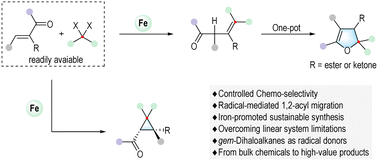
The ability to harness divergent reactivity and selectively dictate product outcomes from simple precursors has been a longstanding challenge in organic chemistry especially in radical chemistry. Herein, we developed a sustainable reaction model leveraging earth-abundant iron as a reductant and gem-dihaloalkanes as radical donors to convert commodity α,βunsaturated compounds into β,γ-unsaturated compounds or cyclopropanes in a tunable manner. The formation of former undergoes an unusual radical-mediated 1,2-acyl migrations and the generation of latter involve an intramolecular radicalradical coupling. Moreover, the chemoselectivity could be effectively controlled by the solvent effects. This study not only provides a practical platform for synthesizing functionalized building blocks but also unlocks novel reactivity modes for gem-dihaloalkanes, positioning them as key tools for sustainable radical-involved transformations.
Supplementary files

Article information

Article type
Edge Article
Submitted
25 Feb 2026
Accepted
08 May 2026
First published
11 May 2026
This article is Open Access

All publication charges for this article have been paid for by the Royal Society of Chemistry
Creative Commons BY-NC license

Chem. Sci., 2026, Accepted Manuscript

Iron-mediated Reactions of gem-Dihaloalkanes with α,β-Unsaturated Carbonyl Compounds

G. Wang, J. Yao, J. Liu, T. Zhang, X. Cheng, L. Li, M. Han and B. Li, Chem. Sci., 2026, Accepted Manuscript , DOI: 10.1039/D6SC01614F

This article is licensed under a Creative Commons Attribution-NonCommercial 3.0 Unported Licence. You can use material from this article in other publications, without requesting further permission from the RSC, provided that the correct acknowledgement is given and it is not used for commercial purposes.

To request permission to reproduce material from this article in a commercial publication, please go to the Copyright Clearance Center request page.

If you are an author contributing to an RSC publication, you do not need to request permission provided correct acknowledgement is given.

If you are the author of this article, you do not need to request permission to reproduce figures and diagrams provided correct acknowledgement is given. If you want to reproduce the whole article in a third-party commercial publication (excluding your thesis/dissertation for which permission is not required) please go to the Copyright Clearance Center request page.

Read more about how to correctly acknowledge RSC content.

Social activity

Spotlight

Advertisements