


 PLATFORM UPDATE:


Mechanistic insights into azo compound back-isomerization from spin-flip time-dependent DFT combined with Marcus theory

Abstract
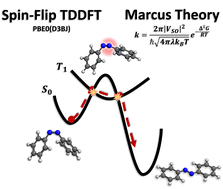
Interest in photosensitive molecules has increased significantly over the past decade, with particular attention given to photoswitchable systems. Among these, azobenzene stands out as a reference compound due to its broad range of applications, in particular for solar energy storage. While the trans-to-cis photoisomerization has been relatively well characterized, the reverse cis-to-trans isomerization remains a complex process potentially involving multi-state physics. In this study, we compile recent theoretical advances aimed at modeling this process and introduce, through the spin-flip time-dependent density functional theory (SF-TDDFT) approach combined with the semi-classical Marcus equation, a fast and efficient method to investigate the mechanisms of thermal back-isomerization of azo derivatives. By comparing various exchange–correlation functionals with CASPT2 reference data, we demonstrate that the PBE0(D3BJ) functional provides an accurate description for the non-adiabatic rotational pathway. We successfully reproduce the experimental values (88.6 vs. 88.3 kJ mol−1 for the experimental enthalpy of activation, and −53.0 vs. −50.2 J mol−1 K−1 for the experimental entropy of activation) for azobenzene, thus motivating the extension of this methodology to other azo derivatives. This approach can be further generalized to a broader class of azo-based photo-switches in future studies.
 Please wait while we load your content...


