


 PLATFORM UPDATE:


ZrO2-induced d–d spatial coordination effects of Ru single-atom catalysts to boost the oxygen evolution reaction
 *b
*b
Abstract
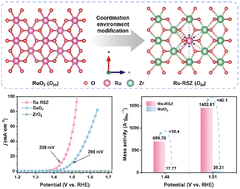
Proton exchange membrane water electrolysis (PEMWE) is a leading strategy for producing green hydrogen from intermittent renewable energy. However, the high anodic energy barrier of the oxygen evolution reaction (OER), in a strongly acidic and highly oxidative operating environment, poses severe challenges for catalyst design. Herein, based on a unique d–d spatial coordination design, tetragonal zirconia-supported Ru single-atom catalysts (Ru-RSZ) were synthesized, which exhibited an overpotential as low as 208 mV and a mass activity of 1452.61 A gRu−1 @ 1.51 V. Remarkably, these catalysts were stably operated for 500 h. X-ray absorption spectroscopy (XAS) and high-angle annular dark-field (HAADF) imaging demonstrated that Ru is atomically dispersed at Zr lattice sites in ZrO2, and the point-group symmetry of the Ru atom changes from D2h in RuO2 to D2d. Density functional theory (DFT) calculations elucidated that the d-band center of Ru atoms was lowered by d–d spatial coordination effects, which weakened the strong adsorption of oxygen at Ru sites, eventually reducing the activation barrier of the OER rate-determining step. This work paves a new avenue to design high-efficiency and stable catalysts for hydrogen production.
 Please wait while we load your content...


