Pulsed electrolysis enables unexpected lactonization of bicyclobutane carboxylic acids

Abstract

Anodic oxidation of bicyclobutane carboxylic acids leads to unexpected lactonization and provides access to substituted benzene bioisosteres from highly strained precursors. High selectivity was achieved under pulsed electrolysis. Mechanistic experiments, supported by computational analysis, indicate that the transformation is initiated by single-electron oxidation of the substrate to form a bicyclobutyl radical cation, a key intermediate in redox-mediated transformations. These results demonstrate the utility of electrochemical methods for controlling the reactivity of bicyclobutane derivatives and provide a foundation for further development of sustainable oxidative transformations of strained molecules.
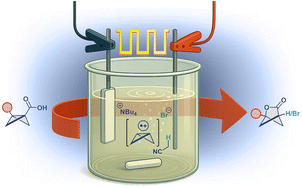
Graphical abstract: Pulsed electrolysis enables unexpected lactonization of bicyclobutane carboxylic acids

Supplementary files

Article information

Article type
Edge Article
Submitted
23 Feb 2026
Accepted
20 May 2026
First published
04 Jun 2026
This article is Open Access

All publication charges for this article have been paid for by the Royal Society of Chemistry
Creative Commons BY-NC license

Chem. Sci., 2026, Advance Article

Pulsed electrolysis enables unexpected lactonization of bicyclobutane carboxylic acids

A. S. Makarov, L. Yi, B. Maity, L. Cavallo and M. Rueping, Chem. Sci., 2026, Advance Article , DOI: 10.1039/D6SC01541G

This article is licensed under a Creative Commons Attribution-NonCommercial 3.0 Unported Licence. You can use material from this article in other publications, without requesting further permission from the RSC, provided that the correct acknowledgement is given and it is not used for commercial purposes.

To request permission to reproduce material from this article in a commercial publication, please go to the Copyright Clearance Center request page.

If you are an author contributing to an RSC publication, you do not need to request permission provided correct acknowledgement is given.

If you are the author of this article, you do not need to request permission to reproduce figures and diagrams provided correct acknowledgement is given. If you want to reproduce the whole article in a third-party commercial publication (excluding your thesis/dissertation for which permission is not required) please go to the Copyright Clearance Center request page.

Read more about how to correctly acknowledge RSC content.

Social activity

Spotlight

Advertisements