


 PLATFORM UPDATE:


Capturing elusive alkenyl radicals in the Wharton reaction and its interrupted cyclization

Abstract
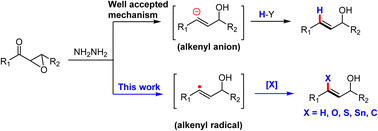
The Wharton reaction is a widely used transformation in organic synthesis, enabling the conversion of α,β-epoxy ketones into versatile allylic alcohols. Despite its discovery more than 60 years ago, the detailed mechanism has remained elusive and controversial. While the prevailing mechanism involves the intermediate of an alkenyl anion, several sporadic reports have challenged this pathway, instead suggesting the involvement of an alkenyl radical. Yet no direct evidence has been provided for either species. Herein, we report the first direct capture of the elusive alkenyl radical intermediate in the Wharton reaction using well-established radical traps, including TEMPO (a persistent radical scavenger), PhSSPh, Me3SnSnMe3, and a vinyl cyclopropane radical clock. These experiments furnish the first unambiguous chemical evidence for the generation of alkenyl radicals and effectively rule out the alkenyl anion pathway. Furthermore, we discovered an interrupted Wharton reaction in which the alkenyl radicals are efficiently intercepted by tethered arenes under the standard Wharton reaction conditions, leading to novel cyclized products. These cycloadducts offer valuable intermediates for the total synthesis of polycyclic diarylheptanoid musellarins.
 Please wait while we load your content...


