


 PLATFORM UPDATE:


Single-atom cocatalysts engineer proton microenvironments for efficient alkaline hydrogen evolution
 ab
and
Yi
Cui
*ab
ab
and
Yi
Cui
*ab
Abstract
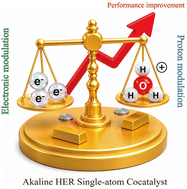
Single-atom catalysts (SACs) are traditionally designed as the primary active sites for catalytic reactions. Here, we advance a fundamentally different conceptual framework by redefining single-atom sites as cocatalytic regulators that orchestrate reaction microenvironments rather than directly participating in catalytic turnover. Taking alkaline hydrogen evolution (HER) on Ru nanoparticles as a model reaction, we demonstrate through DFT calculations that Mo, W, and Cr single-atom cocatalysts—although intrinsically poor in hydrogen adsorption—significantly optimize the ΔGH* of neighboring Ru sites. Guided by this prediction, we synthesize Mo–Ru@CNT, which achieves near-zero overpotential at 10 mA cm−2, a Tafel slope of 25.34 mV dec−1, and a turnover frequency of 15.49 s−1 at an overpotential of 100 mV—far exceeding the performance of Ru@CNT without cocatalysts. Multi-scale characterization further revealed that the role of the single-atom cocatalyst extends beyond electronic modulation. The introduction of Mo/W/Cr single-atom sites can in situ generate Brønsted acidic sites during the reaction, regulating the proton concentration near the Ru sites and constructing a proton-enriched acid-like interfacial microenvironment on the Ru surface. This work redefines the functional scope of single-atom materials from active centers to cocatalytic regulators, opening a new design dimension for complex multi-step electrocatalytic reactions.
- This article is part of the themed collection: 2026 Chemical Science HOT Article Collection
 Please wait while we load your content...


