


 PLATFORM UPDATE:


Ultralong organic room-temperature phosphorescence of tetraphenylene via lactose functionalization and chromophore isolation

Abstract
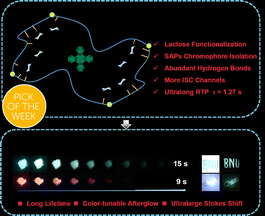
Achieving efficient and ultralong room-temperature phosphorescence (RTP) in purely organic systems is challenging. This work addresses this issue by unlocking unprecedented RTP performance in nonplanar tetraphenylene (TeP), a chromophore traditionally limited by aggregation-induced quenching and poor processability. Through an innovative dual strategy of lactose functionalization and supramolecular chromophore isolation within superabsorbent polymers (SAPs), ultralong organic RTP is achieved with lifetimes (τ) of 1.27 s (298 K) and 2.21 s (77 K). Serving as a host matrix, the SAPs provide a rigid environment that effectively isolates the chromophores and suppresses non-radiative decay. Concurrently, lactose functionalization confers high aqueous solubility, thereby significantly broadening the scope of practical applications. Furthermore, a high performance supramolecular Förster resonance energy transfer (FRET) system is constructed via the co-assembly of fluorescent acceptors with the RTP matrix, enabling long-lived multicolor afterglow (>200 ms, naked-eye visible), redshifted emission (584–753 nm), and ultralarge Stokes shifts (up to 473 nm). These advancements facilitate applications in information encryption and afterglow displays. This work not only reveals the untapped potential of TeP for ultralong RTP but also establishes carbohydrate functionalization as a versatile paradigm for designing next generation, amorphous, and organic RTP materials with specific properties.
- This article is part of the themed collections: 2026 Chemical Science HOT Article Collection and 2026 ChemSci Pick of the Week Collection
 Please wait while we load your content...


