


 PLATFORM UPDATE:


Precise construction of symmetrically coordinated triatomic zirconium catalyst for efficient oxygen reduction
 *a
and
Jingqi
Guan
*a
*a
and
Jingqi
Guan
*a
Abstract
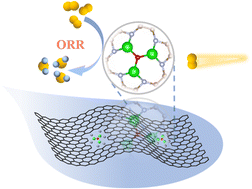
Developing an environmentally friendly, highly efficient, and stable electrocatalyst for the oxygen reduction reaction (ORR) holds critical importance for advancing the commercial viability of zinc–air batteries (ZABs). The d-band electronic structure of metal atoms in triatomic catalysts (TACs) can be precisely regulated to achieve the optimal adsorption energy for oxygen intermediates (*OOH, *O and *OH). Here, a TAC Zr3/NG with Zr3O1N6 active sites has been successfully synthesized by a Joule heating method for the ORR. The Zr3/NG demonstrates a half-wave potential (E1/2) of 0.857 V, better than that of single-atom Zr1/NG and commercial Pt/C. Furthermore, the ZAB based on Zr3/NG can achieve a maximum peak power density of 164.3 mW cm−2 and retains stable operation for over 175 h. Theoretical studies reveal that the Zr3O1N6 coordination configuration shifts the d-band center of zirconium toward the Fermi level, effectively adjusting the adsorption energy of the oxygen intermediate by elongating the O–O bond through bridge adsorption, thereby effectively promoting the breaking of the bond. This study reveals the synergistic effect of triatomic zirconium active centers for improving the ORR performance.
 Please wait while we load your content...


