


 PLATFORM UPDATE:


Orbital hybridization-mediated synergistic multi-electron redox in a NASICON cathode unlocking solid-solution reactions for ultrafast and durable sodium storage
 b
Xing-Long
Wu
*b
b
Xing-Long
Wu
*b
Abstract
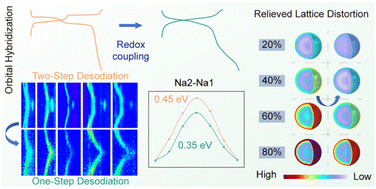
Na4VMn(PO4)3, as a high-energy-density and low-cost cathode material for sodium-ion batteries (SIBs), holds promising application prospects. However, its practical performance is limited by the stepwise redox reactions of V and Mn, which induce significant phase transitions and sluggish kinetics, particularly during the second desodiation process. To address this issue, we propose an orbital hybridization regulation strategy based on Ti/Fe co-doping. By tailoring the local coordination environment, the introduced Ti/Fe constructs a 3d–3d metallic network, inducing continuous multi-orbital hybridization. This transforms the V/Mn redox process from stepwise to simultaneous, eliminating sharp phase boundaries and overcoming the kinetic bottleneck in the second desodiation step. Additionally, the d-band energy level difference between V and Mn is narrowed to 0.701 eV, enhancing electron delocalization and intrinsic conductivity, thereby enabling highly reversible multi-electron transfer processes. The optimized Na3.75V0.75Mn0.75Ti0.25Fe0.25(PO4)3 effectively mitigates volumetric stress and local phase transitions, ensuring structural integrity. Consequently, the material retains 73% capacity after 2000 cycles at 10C, demonstrating superior rate capability and cycling stability. This work provides crucial electronic-level insights and a novel design paradigm for high-performance SIB cathode materials.
 Please wait while we load your content...


