


 PLATFORM UPDATE:

Porous organic polymers based on carbon–carbon coupling reaction: synthesis and applications
 *a
and
Guangshan
Zhu
*a
*a
and
Guangshan
Zhu
*a
Abstract
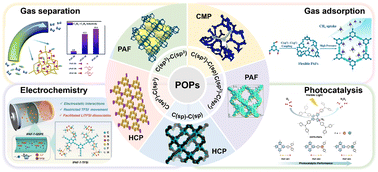
Porous organic polymers (POPs) are a class of materials formed by covalent bonding, which possess large specific surface area, good physical and chemical stability, and strong designability. Among these, POPs constructed through carbon–carbon coupling, including conjugated microporous polymers (CMPs), porous aromatic frameworks (PAFs), hypercrosslinked porous polymers (HCPs), and porous polymer networks (PPNs), generally show higher stability than those connected by reversible covalent bonds. These POPs can retain their structural stability even under harsh chemical conditions. This remarkable stability enables them to undergo diverse chemical functionalization modifications, thereby endowing them with broad application prospects that align more closely with practical requirements. Carbon–carbon coupling reactions are the core synthetic strategy for constructing POPs, mainly including classic reaction types such as Ullmann coupling, Sonogashira–Hagihara cross-coupling, Suzuki–Miyaura cross-coupling, Heck cross-coupling, Eglinton coupling, and Friedel–Crafts alkylation reaction. These reactions correspondingly enable the formation of five types of carbon–carbon bonds via coupling reactions, including C(sp2)–C(sp), C(sp2)–C(sp2), C(sp)–C(sp), C(sp2)–C(sp3), and C(sp3)–C(sp3). By precisely regulating monomer structures, catalyst systems, and reaction conditions, key parameters of POPs such as pore size, specific surface area, and surface chemical properties can be directionally designed, thereby obtaining material structures that meet specific application requirements. POPs have been attracting wide attention because of their excellent performances in gas adsorption, gas separation, catalysis, electrochemistry, and many other fields. Moving forward, carbon–carbon coupling reactions have unique potential in expanding the structural diversity of POPs and developing new functional porous materials, representing a promising direction for focused exploration in the field of POP synthesis.
- This article is part of the themed collection: 2026 Chemical Science Perspective & Review Collection
 Please wait while we load your content...


