


 PLATFORM UPDATE:


Ultrasmooth and thin pheomelanin-like film as a metal-free electrocatalytic enhancer
 †a
Jae Ryeol
Jeong,
†a
Seong Ah
Jo,
†a
Myung Jun
Kim,
b
Minho
Kim,
*a
Min Hyung
Lee
*a
†a
Jae Ryeol
Jeong,
†a
Seong Ah
Jo,
†a
Myung Jun
Kim,
b
Minho
Kim,
*a
Min Hyung
Lee
*a
Abstract
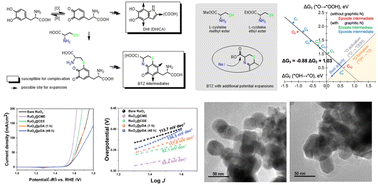
This study explores a bioinspired approach to enhance electrocatalytic oxygen evolution reaction (OER) performance by employing a pheomelanin-like thin film. Inspired by the complex chemistry of natural pigments, we developed an ultrasmooth and exceptionally thin organic coating by introducing cysteine derivatives into dopamine-based solutions. The resulting films, approximately 2 nm thick, form conformal layers on conventional RuO2 electrocatalysts and significantly reduce the overpotential required for the OER. Specifically, coatings with cysteine methyl ester (CME) or cysteine ethyl ester (CEE) achieved overpotential reductions of up to 34 mV at 10 mA cm−2 compared to pristine RuO2. Beyond improved catalytic performance, the films exhibited unique deposition kinetics characterized by an autocatalytic “bursting” behavior, highlighting the emergent properties of the system. Our findings underscore the potential of bioinspired organic materials to modulate electrocatalytic interfaces, offering new strategies for the rational design of hybrid catalytic systems in energy conversion technologies.
 Please wait while we load your content...


