


 PLATFORM UPDATE:


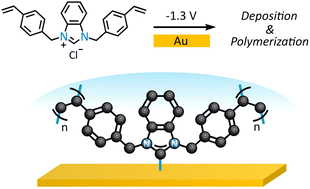
Combined electrodeposition and electropolymerization method to produce surface-bound polystyrenyl NHC thin films
 ab
James J.
Noël,
*abd
Cathleen M.
Crudden,
*bc
Joe B.
Gilroy
*ab
and
Paul J.
Ragogna
*abd
ab
James J.
Noël,
*abd
Cathleen M.
Crudden,
*bc
Joe B.
Gilroy
*ab
and
Paul J.
Ragogna
*abd
Abstract
Polymeric N-heterocyclic carbene (NHC) films offer a promising strategy for generating durable protective coatings on metals. Polystyrenyl NHC films were constructed on gold in a one step process that combined electrodeposition and electropolymerization of styrenyl benzimidazolium halide precursors at −1.3 V vs. Ag/AgCl for 5 min. Ellipsometry confirmed the nanometer scale films on Au were formed with thicknesses of 1.2–2.9 ± 0.2 nm, while non-polymerizable controls were ≤0.8 nm. Cyclic voltammetry showed strong surface passivation for all polystyrenyl NHC films relative to the monomeric analogues. Area selective deposition on the NHC precursors was evaluated on patterned Au/SiO2 with excellent selectivity factors up to 0.90. These results establish polystyrenyl NHC films as robust nanometer-thick inhibitor coatings that couple strong NHC–metal bonding with the hydrophobic insulating character of polystyrene.
- This article is part of the themed collection: 2026 Chemical Science Covers
 Please wait while we load your content...


