Site-selective bromination of anthracene–maleimide Diels–Alder crystals for tunable afterglow and white light emission

Abstract

Efficient and color-tunable organic persistent room-temperature phosphorescence (p-RTP) is highly attractive for applications in colorful displays, advanced information encryption, and sensing. However, achieving such p-RTP remains challenging due to the lack of effective design strategies. Here, we introduce a synergistic chromophore-engineering approach that couples conventional and nonconventional luminophores to construct donor–acceptor adducts. These adducts exhibit dual fluorescence/p-RTP with pronounced excitation-dependent color tunability, even in crystals. Anthracene bromination (BAN/DBAN-MI) enhances SOC via the heavy-atom effect and increases Φp to 21.5% (DBAN-MI). By contrast, maleimide bromination (AN-BMI/AN-DBMI) reorganizes packing and redistributes through-space conjugation (TSC), enabling single-component white emission. Single-crystal analysis, femtosecond transient absorption spectroscopy, and theoretical calculations reveal how site-specific halogenation governs ISC and clustering-triggered emission (CTE) behaviors. This work establishes a general design principle for efficient and color-tunable organic p-RTP materials combining both aromatic and nonaromatic moieties through the CTE mechanism, highlighting their potential in multicolor displays and white-light illumination.
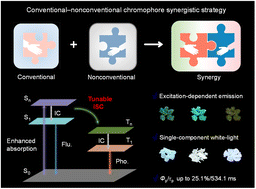
Graphical abstract: Site-selective bromination of anthracene–maleimide Diels–Alder crystals for tunable afterglow and white light emission

Supplementary files

Transparent peer review

To support increased transparency, we offer authors the option to publish the peer review history alongside their article.

View this article’s peer review history

Article information

Article type
Edge Article
Submitted
20 Jan 2026
Accepted
08 Mar 2026
First published
16 Mar 2026
This article is Open Access

All publication charges for this article have been paid for by the Royal Society of Chemistry
Creative Commons BY-NC license

Chem. Sci., 2026, Advance Article

Site-selective bromination of anthracene–maleimide Diels–Alder crystals for tunable afterglow and white light emission

G. Yang, T. Zhu, X. Chen, J. Duan, Z. Zhao and W. Z. Yuan, Chem. Sci., 2026, Advance Article , DOI: 10.1039/D6SC00542J

This article is licensed under a Creative Commons Attribution-NonCommercial 3.0 Unported Licence. You can use material from this article in other publications, without requesting further permission from the RSC, provided that the correct acknowledgement is given and it is not used for commercial purposes.

To request permission to reproduce material from this article in a commercial publication, please go to the Copyright Clearance Center request page.

If you are an author contributing to an RSC publication, you do not need to request permission provided correct acknowledgement is given.

If you are the author of this article, you do not need to request permission to reproduce figures and diagrams provided correct acknowledgement is given. If you want to reproduce the whole article in a third-party commercial publication (excluding your thesis/dissertation for which permission is not required) please go to the Copyright Clearance Center request page.

Read more about how to correctly acknowledge RSC content.

Social activity

Spotlight

Advertisements