


 PLATFORM UPDATE:


Geometric orthogonality as a recipe for efficient intramolecular charge generation in core substituted NDI derivatives
 †c
Dejan-Krešimir
Bučar,
b
Alethea B.
Tabor,
b
Bob C.
Schroeder,
b
Sandra
Gómez
*d
and
Jose M.
Marin-Beloqui
*ef
†c
Dejan-Krešimir
Bučar,
b
Alethea B.
Tabor,
b
Bob C.
Schroeder,
b
Sandra
Gómez
*d
and
Jose M.
Marin-Beloqui
*ef
Abstract
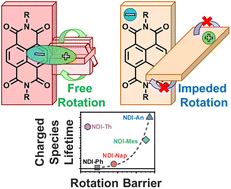
One of the primary drawbacks of organic materials, compared to their inorganic counterparts in various optoelectronic applications, is their lower charge generation efficiency, which stems from their inherently higher exciton binding energy. Therefore, new out-of-the-box approaches need to be introduced to the field. Herein, we propose a new approach to increase the charge formation of naphthalenediimide (NDI) derivatives by inducing a large torsional angle between the NDI core and the core-attached substituent, deconjugating the resulting extended π-system. To study the extent of this change, transient absorption spectroscopy characterisation has been performed on a set of derivatised NDI molecules where the core-attached substituents have been systematically altered to modulate the resulting torsional angle. The data indicates an enhanced charge generation with core-attached substituents from phenyl to anthracenyl which increase in both size and degree of rotational inhibition. State-of-the-art excited state simulations using the TD-B3LYP/def2-SVP level of theory were performed to calculate absorption spectra and to parametrise potential energy surfaces to run non-adiabatic quantum dynamics simulations for the two extreme NDI systems, showing crucial differences due to the influence of charge transfer states. This opens the possibility for a new family of NDI molecules with implications for a wide range of applications such as photovoltaics, transistors and catalysis.
 Please wait while we load your content...


