


 PLATFORM UPDATE:


Molecular basis for the biosynthetic divergence of anthracyclines kosinostatin and chartreusin
 *ad
and
Yi Shuang
Wang
*a
*ad
and
Yi Shuang
Wang
*a
Abstract
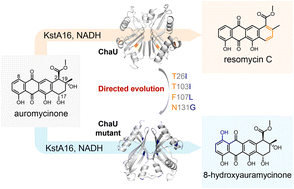
Kosinostatin and chartreusin are both anthracycline-type antitumor agents. The structure of kosinostatin incorporates a spirally fused pyrrolopyrrole moiety attached to a five-membered ring of its anthraquinone core, whereas chartreusin possesses a distinct, rearranged pentacyclic aromatic dilactone aglycone. Biosynthetic divergence in kosinostatin and chartreusin is governed by highly homologous proteins, KstA15 and ChaU, which catalyze phenol hydroxylation and hydration, respectively. In this report, we successfully engineered a functional swap between ChaU and KstA15 via directed evolution. The crystal structure of the ChaU mutant along with molecular dynamics simulations elucidated the structural determinants of its catalytic specificity, revealing the critical residue interactions and conformational dynamics. Furthermore, a ubiquitous distribution of KstA15-like proteins across microbial genomes has been demonstrated through gene mining. These findings deliver key insights into the evolutionary trajectory of functionally divergent enzymes and create a robust framework for rationally engineering biosynthetic pathways to produce novel anthracycline derivatives with potential pharmaceutical applications.
 Please wait while we load your content...


