


 PLATFORM UPDATE:

Spin effect regulation as a design principle for M–N–C catalysts for oxygen electrocatalysis

Abstract
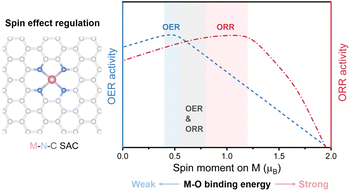
Recent advances indicate that regulating the spin state of metal centers can markedly modulate catalytic performance, motivating interest in exploiting spin effects for the design of highly efficient oxygen electrocatalysts. However, the fundamental mechanisms linking spin state and activity remain insufficiently understood. Herein, M–N–C catalysts (M = Fe/Co/Ni) with atomically well-defined coordination environments are employed to systematically analyze spin effects on oxygen electrocatalysis, enabling precise control of the metal-center spin state via local coordination tuning. By means of density functional theory calculations and state-of-the-art microkinetic volcano modeling, we show clear scaling correlations between the spin moment of metal center and the adsorption energies of key intermediates (i.e., HO*, O*, and HOO*) of Fe/Co/Ni single-atom sites, which in turn dictate activity trends in oxygen evolution and reduction reaction (ORR and OER) activities through the modulation of the metal-center spin. Interestingly, optimal spin moments of 0.5, 1.0, and 0.65 µB correspond to OER, ORR, and bifunctional oxygen electrocatalysis, respectively. Leveraging the spin moment as activity descriptors, we rapidly screened spin states of Fe/Co/Ni sites on three dual-atom M–N–C frameworks and predicted highly active oxygen electrocatalysts, subsequently validated by DFT calculations. These findings establish a rapid, quantitative, spin effect-based design principle for rational development and accelerated discovery of high-performance oxygen electrocatalysts.
- This article is part of the themed collections: 2026 Chemical Science HOT Article Collection and 2026 Chemical Science Covers
 Please wait while we load your content...


