


 PLATFORM UPDATE:


How solvent activity and solute solvation control electrode potentials: quantitative insights from Li+ insertion into TiO2
 *a
and
Véronique
Balland
*a
*a
and
Véronique
Balland
*a
Abstract
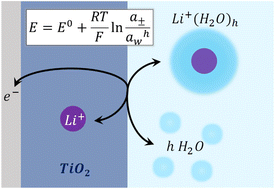
Tuning electrolyte salt concentration has emerged as a powerful strategy to enhance the performance of rechargeable batteries by mitigating parasitic side reactions. Here, we introduce a unified and quantitative validation of an electrolyte thermodynamic framework incoporated into a modified Nernst equation that explicitly includes electrolyte-specific parameters—namely, salt and solvent activities, as well as the salt hydration number—to rationalize and predict how electrode potentials vary with electrolyte concentration in reversible ion-insertion systems. We demonstrate this generic methodology for reversible Li+ insertion into anatase TiO2 using aqueous LiCl electrolytes. By combining tabulated water and LiCl activities with concentration-dependent hydration numbers derived from both experimental and theoretical approaches, we achieve quantitative agreement between predicted and measured potential shifts. This work establishes a reliable and broadly applicable framework for deciphering and controlling electrolyte-concentration effects in batteries and, more generally, in electrochemical systems involving concentrated electrolytes.
 Please wait while we load your content...


