


 PLATFORM UPDATE:

Glutathione-activatable synthetic channel for hopping-mediated anion transport

Abstract
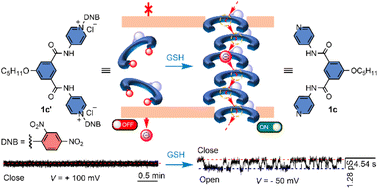
Controlled transport of ions across the cellular membrane is an essential process. While nature employs stimuli-gated transmembrane proteins to facilitate the appropriate transport of essential ions or molecules across cellular membranes, the endeavor to create a stimuli-controlled synthetic analogue presents considerable challenges. Herein, we introduced isophthalamide-based synthetic ion transporters 1a–1e and a protransporter 1c′. Transport studies divulged that even though the protransporter 1c′ cannot transport the anions, the glutathione-based activation generates a self-assembled anion channel 1c in the membrane and turns ON the anion transport with preferential selectivity towards the chloride anion. Detailed mechanistic studies validated that the transport of anions occurs via the antiport mechanism. An electrophysiological experiment divulged that the protransporter is inefficient in forming stable channels in the membrane. In contrast, the addition of the GSH releases the compound 1c, which forms a stable channel in the membrane with an average diameter of 4.7 ± 0.3 Å. The calculated single-channel conductance is 165 ± 1 pS, and the average PCl−/PK+ = 5.0 ± 1.3. A dodecameric assembly of the monomeric rosette of 1c and [(1c)12 + Cl−] was geometrically optimized to understand the ion channel formation and investigate the responsible channel–ion interactions for the ion transport process.
- This article is part of the themed collection: Chemical Science Leaders in the Field Symposium 2024 Speakers Collection
 Please wait while we load your content...


