


 PLATFORM UPDATE:


Controlling triplet-pair formation in acene-bridged trimers through locally excited–charge-transfer state mixing†
 a
Daniel G.
Congrave,
‡bc
Jeroen
Royakkers,
‡b
Julia
Osmólska,
a
Oliver
Millington,
b
Murad J. Y.
Tayebjee,
e
Luis M.
Campos,
d
Hugo
Bronstein
*ab
and
Akshay
Rao
*a
a
Daniel G.
Congrave,
‡bc
Jeroen
Royakkers,
‡b
Julia
Osmólska,
a
Oliver
Millington,
b
Murad J. Y.
Tayebjee,
e
Luis M.
Campos,
d
Hugo
Bronstein
*ab
and
Akshay
Rao
*a
Abstract
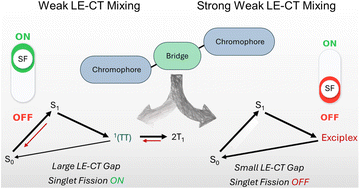
Singlet fission (SF) offers a pathway to surpass conventional efficiency limits in photovoltaics, yet how bridge–chromophore coupling governs locally excited/charge-transfer state (LE–CT) mixing and thereby the multiexciton yield remains elusive. We design three systems, TIPS-BT0, TIPS-TAT, and Encap-TAT, that progressively increase bridge–chromophore coupling. Steady-state spectroscopy and transient absorption reveal that TIPS-BT0 and TIPS-TAT undergo efficient SF, forming correlated triplet pairs (1TT) and, in TIPS-TAT, long-lived triplets. By contrast, Encap-TAT loses vibronic structure and relaxes ultrafast into a broad, red-shifted intramolecular exciplex-like (Ex) state. Quantum chemical analysis shows that the Ex state originates from strong hybridization between local excitations (LEs) and bridge–chromophore CT configurations, driven by large electron and hole transfer integrals and a small LE–CT energy gap. Such strong LE–CT hybridisation suppresses well-defined 1TT formation, favouring intramolecular Ex emission and enhancing photoluminescence quantum yield (≃80.5% vs. ≃38.5% for TIPS-TAT). These findings establish a unifying framework in which the balance between multiexciton generation and exciplex emission in acene-bridged trimers is governed by the degree of LE–CT mixing. Tuning bridge energetics and LE–CT offsets enables deliberate routing of excited-state pathways toward efficient triplet production or bright exciplex emission, providing actionable design rules for next-generation singlet-fission and optoelectronic architectures.
 Please wait while we load your content...


