


 PLATFORM UPDATE:


Mapping the nonribosomal specificity code through promiscuity-guided A-domain engineering
 c
Hajo
Kries
*ad
c
Hajo
Kries
*ad
Abstract
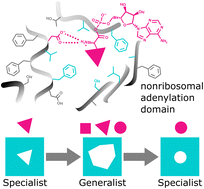
Nonribosomal peptide synthetases (NRPSs) assemble bioactive peptides from various building blocks. The binding pocket residues governing building block specificity have allowed prediction of NRPS products but not design of specificity. A reason for this failure has been ignorance of NRPS multispecificity. Here, we employ a hydroxamate assay (HAMA) to determine multispecificity for mutant libraries of the adenylation (A-)domain in module SrfAC of surfactin synthetase. A multispecific version of SrfAC is developed and its functional flexibility probed by fully randomizing 15 residues around the active site. We identify mutations with profound impact on specificity revealing remarkable evolvability and explain the effect of a selected mutant by computational modelling. Statistical analysis of the specificity divergence caused by 285 point mutations has revealed an outstanding influence of three sequence positions on specificity, which provides a roadmap for NRPS engineering. Our results suggest that promiscuity drives neofunctionalization of A-domains and mimicking this process will help to design valuable peptides in the lab.
 Please wait while we load your content...


