A Dual-Function Molecule Enables Stable Four-Electron Conversion and Zn Deposition for High-Capacity Aqueous Zn-I2 Batteries

Abstract

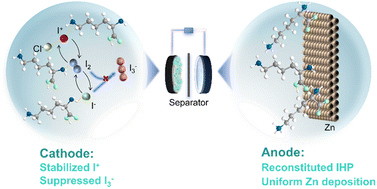
Aqueous zinc-iodine batteries (ZIBs) are a promising energy storage technology due to the abundance of iodine, environmental friendliness, and low cost. This study introduces a multifunctional additive, L-lysine hydrochloride (LLH), designed to activate the four-electron transfer chemistry between I+ and I− species, significantly boosting energy density. LLH stabilizes I⁺ via dual coordination from amino groups and chloride ion, effectively suppressing hydrolysis and enabling reversible "2" 〖"I" ^"-" "/I" 〗_"2" ^"0" "/2" "I" ^"+" conversion. The preferential adsorption of carboxyl group of protonated L-lysine at the zinc anode promotes uniform zinc deposition while inhibiting hydrogen evolution reaction. Additionally, the incorporation of LLH effectively suppresses the shuttle effect by interacting with iodine species through its carboxyl and amino groups. LLH-modified Zn||Zn symmetric batteries demonstrate extended cycling stability, operating beyond 4000 hours, while Zn||I2 full batteries deliver a high specific capacity of 502 mAh g−1 at 1 A g−1. This additive strategy renders a facile and efficient approach to realizing high-capacity and durable ZIBs.
Supplementary files

Transparent peer review

To support increased transparency, we offer authors the option to publish the peer review history alongside their article.

View this article’s peer review history

Article information

Article type
Edge Article
Submitted
08 Jan 2026
Accepted
01 Feb 2026
First published
05 Feb 2026
This article is Open Access

All publication charges for this article have been paid for by the Royal Society of Chemistry
Creative Commons BY-NC license

Chem. Sci., 2026, Accepted Manuscript

A Dual-Function Molecule Enables Stable Four-Electron Conversion and Zn Deposition for High-Capacity Aqueous Zn-I2 Batteries

H. Zhang, X. Zhang, D. Ma, X. Cai, M. Lv, H. Yan, J. Niu and W. Song, Chem. Sci., 2026, Accepted Manuscript , DOI: 10.1039/D6SC00182C

This article is licensed under a Creative Commons Attribution-NonCommercial 3.0 Unported Licence. You can use material from this article in other publications, without requesting further permission from the RSC, provided that the correct acknowledgement is given and it is not used for commercial purposes.

To request permission to reproduce material from this article in a commercial publication, please go to the Copyright Clearance Center request page.

If you are an author contributing to an RSC publication, you do not need to request permission provided correct acknowledgement is given.

If you are the author of this article, you do not need to request permission to reproduce figures and diagrams provided correct acknowledgement is given. If you want to reproduce the whole article in a third-party commercial publication (excluding your thesis/dissertation for which permission is not required) please go to the Copyright Clearance Center request page.

Read more about how to correctly acknowledge RSC content.

Social activity

Spotlight

Advertisements