


 PLATFORM UPDATE:


Origins of the selectivity of late transition metals of Group 9 and Group 10 for oxidative addition of C–H vs. C–Cl bonds
 †a
Alistair J.
Sterling,
†ab
Alexander
Zech,
a
Diptarka
Hait,
a
Martin
Head-Gordon
*a
and
John F.
Hartwig
*a
†a
Alistair J.
Sterling,
†ab
Alexander
Zech,
a
Diptarka
Hait,
a
Martin
Head-Gordon
*a
and
John F.
Hartwig
*a
Abstract
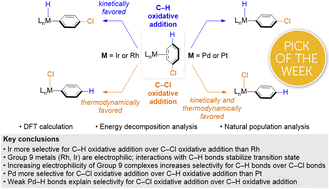
Oxidative addition of carbon–hydrogen or carbon–halogen bonds occurs in many reactions catalyzed by late transition-metal complexes. Metals of Group 9 typically react with C–H bonds faster than C–X bonds, while those of Group 10 react with C–X bonds faster than C–H bonds. We conducted comparative computational studies on the oxidative addition of C–H and C–Cl bonds in chlorobenzene to complexes of Rh, Ir, Pd, and Pt. Our calculations show that addition of an aryl C–Cl bond to complexes of Rh(I) or Ir(I) is thermodynamically more favorable but kinetically less favorable than addition of an aryl C–H bond. Oxidative addition of a C–Cl bond to Pd(0) or Pt(0) complexes is also thermodynamically favorable but addition of an aryl C–H bond to Pd(0) or Pt(0) is less favorable and endergonic. Energy decomposition analysis and natural population analysis of the reactions with Ir(I) and Pd(0) suggest that interactions in the transition state between the electrophilic Ir(I) and the more electron-rich C–H bond are more stabilizing than those between Ir(I) and the more electrophilic C–Cl bond and account for the higher reactivity of C–H bonds, whereas the weakness of the Pd–H bond causes addition of the C–H bond to Pd(0) to be endergonic and less reactive than the C–Cl bond; additional factors, such as Pd(0) and Pt(0) nucleophilicity, also contribute to these selectivities.
- This article is part of the themed collections: 2026 Chemical Science HOT Article Collection and 2026 ChemSci Pick of the Week Collection
 Please wait while we load your content...


