


 PLATFORM UPDATE:

Electrochemical fractionation of stable sulfur isotopes in a rechargeable lithium–sulfur battery: a revisit from the law of mass conservation
 *ab
and
Sen
Xin
*ab
*ab
and
Sen
Xin
*ab
Abstract
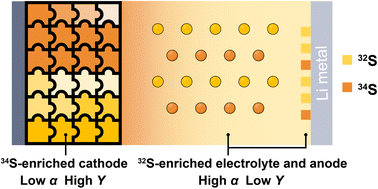
Fractionation of stable 32S/34S isotopes occurs via a ‘lithium polysulfide (LiPS) shuttle’ process upon (dis)charging a Li–S battery, with lighter 32S isotope species with a larger diffusion coefficient enriched at the anode side. However, the global distribution of S isotopes within the battery and its dependence on the state of charge (SoC) of battery remain unclear. In this work, we quantitatively measured the S isotope distribution in the cathode, anode, and electrolyte of a Li–S battery at different SoCs using triple-quadrupole inductively coupled plasma mass spectrometry (TQ-ICP-MS). By establishing a unified sample pretreatment protocol for all S species, we demonstrate, for the first time, mass conservation of S isotopes within a cycled Li–S battery. Loss of active 32S species from the cathode to the electrolyte (and finally to the anode) accounts for enrichment of 34S species at the cathode during battery cycling. Based on isotope mass conservation, the separation factors of 32S and 34S were found to be positively correlated, while trade-offs were found both between the single-stage yields of the two isotopes and between the separation factor and yield of a given isotope. Our findings help define the boundary conditions for key parameters (e.g., separation factors, yields and stages) for electrochemical cascade separation of stable S isotopes.
 Please wait while we load your content...


