


 PLATFORM UPDATE:

Jahn–Teller distortion controls electron transfer in photoexcited Cu(i) donor–acceptor systems

Abstract
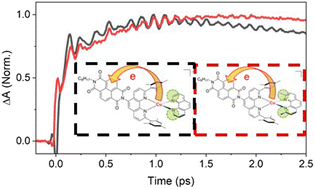
The Jahn–Teller distortion (JTD) is a defining structural response to electronic excitation in Cu(I)-based transition metal complexes, yet its role in photoinduced electron transfer (PET) remains largely unexplored. Here, we demonstrate that the JTD governs charge separation (CS) through a vibronically controlled conical intersection in heteroleptic Cu(I) bisphenanthroline–naphthalene diimide (CuHETPHEN-NDI) donor–acceptor dyads. Using 20-fs broadband transient absorption spectroscopy combined with coherent vibrational wavepacket (CVWP) analysis and quantum chemical calculations, we directly track nuclear motions that steer the system from the metal-to-ligand charge-transfer (1MLCT) state to the CS state. Steric bulkiness of the pendant groups at the 2,9-positions of the phenanthroline ligand systematically slows both JTD and CS. Short-time Fourier transformation and Fourier filtering analyses identify two key vibrational signatures: a low-frequency breathing mode (∼100 cm−1) via a bond distance change between Cu and ligated Ns (Cu–N) that modulates the NDI anion absorption and acts as a vibronic coupling coordinate, and a higher-frequency mode (∼313 cm−1) that evolves along the PET trajectory. Normal mode analysis and potential energy surface calculations show that the JTD brings the 1MLCT and CS states into degeneracy, while the Cu–N breathing motion dynamically modulates donor–acceptor electronic coupling to enable ultrafast nonadiabatic electron transfer. Steric hindrance exerted by the groups at the 2,9 positions of the phenanthroline ligands suppresses this vibronic coupling, leading to faster CVWP decoherence for the 313 cm−1 mode and slower CS. These findings unravel JTD-controlled vibronic coupling at conical intersection as a governing factor for CS and provide insight into designing Cu-based photosensitizers by harnessing structural dynamics to control PET.
- This article is part of the themed collection: 15th anniversary: Chemical Science community collection
 Please wait while we load your content...


