Influence of Aliovalent Substitution on Structure and Dynamics in Sodium Halide Na3-2xY1-xNbxCl6Solid Electrolytes

Abstract

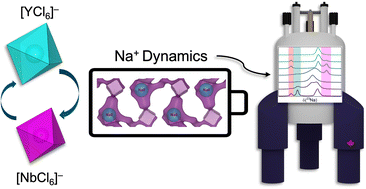
Sodium halide solid electrolytes are garnering increased interest because of their synthetic flexibility to incorporate a variety of cations, thereby altering their structure and properties. Aliovalent substitution is said to increase ionic conductivity by promoting polyanion rotation. Herein, we synthesise and assess a series of Na3-2xY1-xNbxCl6, probing their complex structures using complementary powder X-ray diffraction and variable-temperature 1D and 2D solid-state nuclear magnetic resonance spectroscopy. The bond-valence energy landscapes of the end members are visualised to reveal potential Na-ion transport pathways. A structural threshold is reached for Na2Y0.5Nb0.5Cl6, revealing a limit for Nb polyhedral distortion while the unit cell volume is retained up to 50% Nb substitution. Na2Y0.5Nb0.5Cl6 shows the greatest RT ionic conductivity enhancement in the series, from 10–11 S cm–1 to 10–5 S cm–1.

Supplementary files

Article information

Article type
Edge Article
Submitted
29 Dec 2025
Accepted
25 Feb 2026
First published
26 Feb 2026
This article is Open Access

All publication charges for this article have been paid for by the Royal Society of Chemistry
Creative Commons BY-NC license

Chem. Sci., 2026, Accepted Manuscript

Influence of Aliovalent Substitution on Structure and Dynamics in Sodium Halide Na3-2xY1-xNbxCl6Solid Electrolytes

B. Phan, T. Shuen, D. Vrubleskiy, Q. Yan and V. K. Michaelis, Chem. Sci., 2026, Accepted Manuscript , DOI: 10.1039/D5SC10183B

This article is licensed under a Creative Commons Attribution-NonCommercial 3.0 Unported Licence. You can use material from this article in other publications, without requesting further permission from the RSC, provided that the correct acknowledgement is given and it is not used for commercial purposes.

To request permission to reproduce material from this article in a commercial publication, please go to the Copyright Clearance Center request page.

If you are an author contributing to an RSC publication, you do not need to request permission provided correct acknowledgement is given.

If you are the author of this article, you do not need to request permission to reproduce figures and diagrams provided correct acknowledgement is given. If you want to reproduce the whole article in a third-party commercial publication (excluding your thesis/dissertation for which permission is not required) please go to the Copyright Clearance Center request page.

Read more about how to correctly acknowledge RSC content.

Social activity

Spotlight

Advertisements