


 PLATFORM UPDATE:


Change of the aromatic nature through face-to-face stacking

Abstract
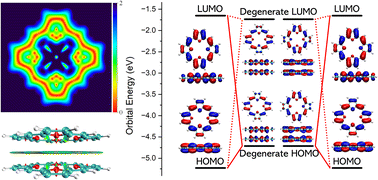
We have computationally studied the aromatic nature of molecules built from tetraoxa-isophlorin (TOI) and Ni(II)-norcorrole (NiNc) moieties. Calculations of the magnetically induced current density (MICD) susceptibility and magnetically induced ring currents (MIRC) show that antiaromatic porphyrinoids form bound aromatic stacked dimers with a distance of about 3 Å between the monomers. We design molecules consisting of many antiaromatic rings because they bind stronger due to the aromatic stabilization and a formal double bond between the individual pairs of the molecular rings of the stacked dimers. Global conjugation and strong coupling between the antiaromatic moieties can be prevented by introducing linkers with formal single bonds between the antiaromatic rings. Cyclooctatetraene (COT) with two ethynyl groups in the para positions is a good linker because the COT and TOI rings contribute to the aromatic binding by becoming aromatic in the stacked dimer. The ethynyl spacers decrease the steric interaction between the TOI rings of the monomer. Calculations with periodic boundary conditions on a surface consisting of TOI rings with ethynyl substituted COT rings as linker molecules showed that the monomer consists of individual antiaromatic rings that form an aromatic stacked dimer structure. The infinite monomer surface has an indirect band gap, whereas the TOI rings of the corresponding dimer is aromatic with a direct band gap. The conjugated pathway of NiNc-based molecules was extended by connecting NiNc rings directly or by ethynyl linkers. NiNc rings connected in the Cβ–Cmeso–Cβ positions are weakly aromatic, whereas those connected in the Cβ–Cβ positions are antiaromatic forming an aromatic dimer. Connecting the NiNc rings with two ethynyl bridges in the Cβ positions leads to locally antiaromatic NiNc and an aromatic stacked dimer. Calculations with periodic boundary conditions on a linear band of NiNc rings show that the band forms a stacked double-decker structure with an intermolecular distance of 2.69 Å.
 Please wait while we load your content...


