


 PLATFORM UPDATE:

A rigid donor unit strategy enables highly efficient narrowband blue multi-resonance thermally activated delayed fluorescence emitters

Abstract
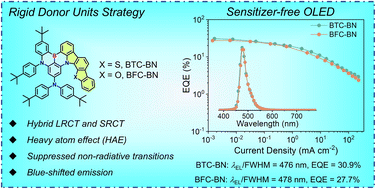
Benzothienocarbazole (BTC) regioisomers, featuring a relatively heavy sulfur atom, a rigid molecular structure, and moderate electron-donating ability, are used in the design of TADF emitters. Here, a comprehensive structural and optoelectronic investigation of two narrowband blue MR-TADF emitters with rigid donor units is presented. A tert-butyldiphenylamine group at the para position of the boron atom gives these molecules a hybrid frontier molecular orbital distribution, showing both short-range charge transfer (SRCT) and long-range charge transfer (LRCT) traits. The rigid donor units not only diminish the high-frequency vibronic coupling strength of the commonly involved stretching modes but also lower the non-radiative decay rate constants of the triplet state. Consequently, these two emitters produce narrowband blue emissions with full width at half maximum (FWHM) values below 23 nm and high photoluminescence quantum yields over 90%. Non-sensitized OLEDs based on BTC-BN and BFC-BN exhibit blue emissions centered at 476 and 478 nm, with FWHMs of 31 and 29 nm, respectively, and maximum EQEs of 30.9% and 27.7%, respectively. This highlights the unique advantages and importance of the rigid donor in controlling the excited state and enhancing device performance.
 Please wait while we load your content...


