


 PLATFORM UPDATE:

Single-B/N MR-TADF emitters enhancing electroluminescence efficiency via a “terminal engineering” strategy

Abstract
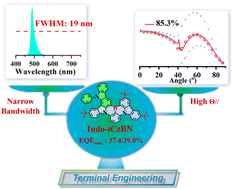
We implemented a “terminal engineering” strategy to address the challenges of low efficiency and the difficulty of effectively narrowing the emission spectra within the single boron–nitrogen (BN) multi-resonance thermally activated delayed fluorescence (MR-TADF) emitter system. By adding flexible diphenylamino groups and insulating tert-butyl (t-Bu) groups, respectively, into the structurally simple CzBN and the polycyclic aromatic hydrocarbon (PAH)-based Indo-CzBN, two novel proof-of-concept MR-TADF emitters, DPA-CzBN and Indo-tCzBN, were successfully developed. Notably, the incorporation of t-butyl units into polycyclic aromatic hydrocarbon (PAH)-structured indolocarbazole derivatives not only markedly suppresses the vibration relaxation of the excited state, enabling Indo-tCzBN to achieve an exceptionally narrow full width at half maximum (FWHM) of 19 nm and a high photoluminescence quantum yield (PLQY) of up to 97.5%, but also significantly enhances the horizontal dipole orientation factor (Θ//) of Indo-tCzBN to 85.3%, compared to approximately 73.6% for Indo-CzBN. Accordingly, benefiting from the synergistic effect of a high Θ// factor and a high PLQY, both the non-sensitized and sensitized organic light-emitting diodes (OLEDs) based on Indo-tCzBN achieved maximum external quantum efficiencies (EQEmax) of 37.4% and 39.0%, respectively. These values rank among the highest reported for MR-TADF emitters constructed on a single BN molecular architecture.
- This article is part of the themed collection: 2026 Chemical Science HOT Article Collection
 Please wait while we load your content...


