


 PLATFORM UPDATE:


Organic supramolecular assemblage-confined photoluminescence
 *a
*a
Abstract
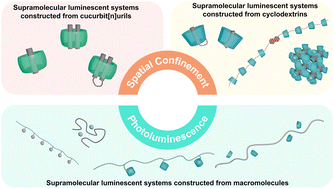
Organic supramolecular hosts can selectively bond to small functional molecules with chromophores, inhibiting molecular motion and isolating quenching factors through spatial confinement, thereby enhancing fluorescence and phosphorescence emission and expanding their applications in chemistry, biology, and materials science. This review mainly focuses on supramolecular luminescent systems constructed from cucurbit[n]urils, cyclodextrins, and other macromolecules. It is very important that cucurbit[n]urils and cyclodextrins both possess rigid hydrophobic cavities, in which cucurbit[n]urils can bond to positively charged guest molecules due to the high negative potential of the carbonyl group at the portal, while cyclodextrin tends to bond to negatively charged guest molecules and has abundant hydroxyl groups, providing numerous modification sites, and both can be further assembled with biomacromolecules through bonding or modification. Biomacromolecules such as hyaluronic acid and chitosan can multivalently bind to guest molecules through electrostatic interactions and hydrogen bonds. Supramolecular luminescent systems formed by these organic macrocyclic hosts or macromolecules and guest molecules have been widely used to construct intelligent supramolecular assemblies and have been successfully applied to near-infrared cell imaging, in situ photodynamic therapy, anti-counterfeiting, information encryption, logic gates, and other fields. With the continuous emergence of novel luminescent groups and new macrocycles, photoluminescence confined within the assembly of organic supramolecular systems will undoubtedly boost their further development in fields such as constructing chiral transfer amplification systems, novel organic light-emitting diodes, and in vivo imaging diagnostics.
- This article is part of the themed collections: 2026 Chemical Science Perspective & Review Collection and Joint collection on photoluminescent organic materials
 Please wait while we load your content...


