


 PLATFORM UPDATE:


Active control of forward/backward charge transfer in Z-scheme water splitting: manipulating electrostatic affinity/repulsion between photocatalyst surface and electron mediator

Abstract
Z-scheme water splitting using semiconductor photocatalysts is a promising strategy for achieving sustainable solar hydrogen production. However, in Z-scheme systems, competition for backward electron transfer, which exerts a substantial influence on the overall quantum efficiency, is thermodynamically unavoidable. In this study, a rational strategy is proposed to overcome the backward electron transfer in Z-scheme water-splitting systems by manipulating the electrostatic affinity/repulsion between photocatalyst surfaces and electron mediators. A designed cationic/neutral charge-switchable [Co(bpc)2]+/0 complex selectively suppressed the backward electron transfer caused by the electrostatic repulsion between the oxidised [Co(bpc)2]+ form and positively surface-charged H2-evolving photocatalyst, to which the forward electron transfer from the reduced [Co(bpc)2]0 form should be negligibly influenced by electrostatic interactions. This selective suppression of backward electron transfer enabled by charge-switchable [Co(bpc)2]+/0 is unique and could not be achieved using conventional cationic (e.g. Fe3+/2+) or anionic (e.g. IO3−/I−) redox mediators. As a result, the [Co(bpc)2]+/0 complex mediator provided the best photocatalytic performance for a benchmark H2-evolving SrTiO3:Rh photocatalyst among the conventional redox mediators and yielded a much improved apparent quantum efficiency of 2.7% for overall water splitting using SrTiO3:Rh and Bi4TaO8Cl photocatalysts. This study establishes a molecular design principle for redox mediators to improve Z-scheme water splitting, shifting the focus beyond the conventional emphasis on engineered photocatalyst materials.
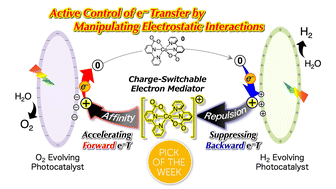
- This article is part of the themed collections: 2026 Chemical Science HOT Article Collection, 2026 Chemical Science Covers and 2026 ChemSci Pick of the Week Collection
 Please wait while we load your content...


