


 PLATFORM UPDATE:


Engineering the electronic structure of Ni–Co bimetallic sites toward efficient electrochemical biomass upgrading and CO2 reduction
 a
Zhao-Qing
Liu
*ab
a
Zhao-Qing
Liu
*ab
Abstract
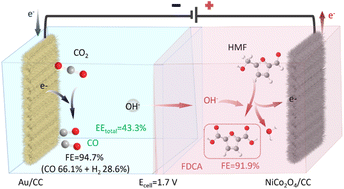
Electrochemical coupling of the 5-hydroxymethylfurfural oxidation reaction (HMFOR) and CO2 reduction reaction (CO2RR) offers a promising route to produce high-value chemicals while lowering the energy input. A critical bottleneck in the CO2-HMF coupled system is the poor ability of the anode catalyst to adsorb and desorb HMF and OH−, resulting in prohibitively high energy consumption. We construct an anode catalyst NiCo2O4 by regulating the tetrahedral site to increase the ratio of Co3+/Co2+, which achieves a faradaic efficiency (FE) for 2,5-furandicarboxylic acid (FDCA) of 99.1% at 1.5 V vs. RHE. The CO2-HMF coupled system with NiCo2O4 as an anode and Au as a cathode at a low cell voltage of 1.7 V affords a total energy conversion efficiency of 43.3%; the FEFDCA of the anode is 91.9%, and the FE of the cathode is 94.7% (66.1% for CO and 28.6% for H2). In-situ surface-enhanced Raman spectroscopy further elucidates the dynamic evolution of the surface state and intermediates of the integrated system: the NiCo2O4 anode promotes HMF-to-FDCA conversion via potential-dependent formation of Ni3+ and Co3+ intermediates for OH− capture. Meanwhile, the key intermediate *CO for CO2-to-CO conversion is detected at the cathode, and the simultaneous progress of the anodic and cathodic reactions significantly reduces the energy consumption of the coupled system. This work provides important theoretical support and a technical approach for the design and amplification of CO2-HMF coupled systems.
- This article is part of the themed collection: 2026 Chemical Science HOT Article Collection
 Please wait while we load your content...


