


 PLATFORM UPDATE:

Lewis acid/NHC dual catalysis for regioselective vicinal decarboxylative carbonylation–acylation of alkenes
 *ab
*ab
Abstract
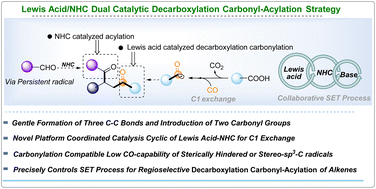
Vicinal difunctionalization of alkenes offers a powerful route to complex carbon architectures by installing two distinct groups. Herein, we describe a novel Lewis acid–thiazolium NHC catalytic system that enables precise control of a single-electron-transfer (SET) process to achieve CO-incorporated vicinal decarboxylative carbonylation–acylation of alkenes. The reaction is proposed to proceed via a concerted SET between the enolate form of the Breslow intermediate and a Lewis acid–activated NHPI ester, followed by CO trapping and regioselective recombination of multiple radical intermediates to install two distinct carbonyl groups. This strategy constitutes a new platform for C1 exchange and enables efficient CO incorporation even with sterically demanding or conformationally rigid alkyl radicals.
 Please wait while we load your content...


