


 PLATFORM UPDATE:


Unraveling the coordination isomerism by ligand hyperfine NMR shifts

Abstract
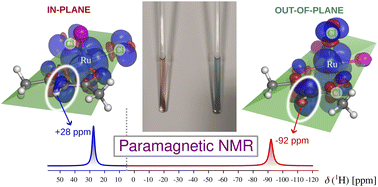
The hyperfine (Curie) NMR shifts of ligand atoms in open-shell coordination compounds report subtle details of the spin distribution around the central metal atom. In this work, we propose hyperfine NMR shifts as simple and extremely sensitive indicators of the ligand coordination geometry. This is demonstrated for equatorial versus axial isomers of neutral octahedral [Ru(acac)Cl2L2] compounds, rationalized by two distinct mechanisms of transmission of the spin density unraveled using density-functional theory analysis. The positional interchange of the two chlorides and the two pnictogen-based ligands (L) induces modifications in the singly occupied molecular orbital composition and the related Fermi-contact hyperfine interactions of the probed atoms of the acac ligand, resulting in distinct 1H and 13C NMR spectral fingerprints. The demonstrated symmetry-driven spin-transmission mechanisms have general validity, which offers hyperfine NMR shifts as a tool to probe the geometry of various classes of coordination compounds, including transition-metal catalysts and metalloenzymes.
 Please wait while we load your content...


