


 PLATFORM UPDATE:


Chiral manganese halide isomers: decoding the spatial stacking effect on second-harmonic generation circular dichroism

Abstract
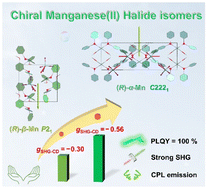
Chiral hybrid metal halides (CHMHs) represent promising candidates for chiral optoelectronics and nonlinear optics (NLO). However, the effect of spatial stacking on second-harmonic generation circular dichroism (SHG-CD) in CHMHs has not been well understood. Herein, we constructed two pairs of chiral manganese(II) halide isomers (R)-α-Mn, (S)-α-Mn, (R)-β-Mn and (S)-β-Mn, which crystallize in chiral space groups C2221 and P21, respectively. They exhibit near-unity photoluminescence quantum yields and efficient circularly polarized luminescence with an asymmetry factor (glum) of ∼1.0 × 10⁻³. Additionally, these isomers show significant NLO responses with SHG intensities of 2.03 and 1.30 times that of KH2PO4 and polarization ratios of up to 0.87 and 0.57 for (R)-α-Mn and (R)-β-Mn, respectively. More importantly, (R)-α-Mn demonstrates an intense SHG-CD response with a SHG-CD factor (gSHG-CD) value of −0.56, about 1.86 times larger than that of (R)-β-Mn (−0.30). Compared to (R)- and (S)-β-Mn, the stacking mode of (R)- and (S)-α-Mn generates a more dense asymmetric hydrogen-bonding network, which greatly distorts [MnBr4]2− tetrahedra and enhances the dipole moment, thereby significantly improving the SHG-CD value. This work elucidates the pivotal role of spatial stacking in chiral NLO materials.
 Please wait while we load your content...


