


 PLATFORM UPDATE:


A poly(trisulfide) oligomer with antimicrobial activity
 a
Witold M.
Bloch,
a
Zhongfan
Jia,
a
Sara J.
Fraser-Miller,
ad
Bart A.
Eijkelkamp,
*a
Tom
Hasell
*c
and
Justin M.
Chalker
*a
a
Witold M.
Bloch,
a
Zhongfan
Jia,
a
Sara J.
Fraser-Miller,
ad
Bart A.
Eijkelkamp,
*a
Tom
Hasell
*c
and
Justin M.
Chalker
*a
Abstract
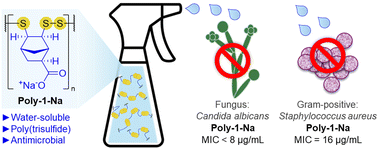
Antimicrobial resistance is a growing threat to human health and agriculture. Sulfur-containing compounds and elemental sulfur have a long history as antimicrobials, but challenges related to solubility have limited their use. Recent advances in sulfur polymer chemistry have enabled the development of novel sulfur-rich materials with antimicrobial activity. However, most of these materials are water-insoluble, limiting their use in medicine and crop protection. Here, we report the synthesis of a linear poly(trisulfide) via photochemical ring-opening polymerization of a cyclic trisulfide monomer bearing a carboxylic acid. Deprotonation of the carboxylic acid renders the poly(trisulfide) water soluble, with concomitant chain scission via S–S cleavage. The resulting poly(trisulfide) oligomers exhibited potent antifungal activity against Candida albicans (CAF 2.1, MIC90 < 8 µg mL−1; SAH 1.1, MIC90 = 128 µg mL−1) and Candida auris (SAH 2.1, MIC90 = 128 µg mL−1). The poly(trisulfide) oligomers also exhibited antibacterial activity against Staphylococcus aureus (USA300, MIC90 = 16 µg mL−1; SH1000, MIC50 < 32 µg mL−1). In control experiments, the monomer alone had much lower antimicrobial activity against C. albicans and S. aureus. Toxicity assays of the poly(trisulfide) oligomer revealed it was not harmful to mammalian cells at these concentrations. The findings are a new direction for biological applications of sulfur polymers and a new strategy to support the battle against antimicrobial resistance.
 Please wait while we load your content...


