


 PLATFORM UPDATE:


An increased throughput workflow to identify ion transport and membrane lysis agents for antimicrobial discovery
 ab
Thomas L.
Allam,
e
Precious I. A.
Popoola,
d
Jose L.
Ortega-Roldan,
d
Jennifer R.
Hiscock
*d
and
Cally J. E.
Haynes
*a
ab
Thomas L.
Allam,
e
Precious I. A.
Popoola,
d
Jose L.
Ortega-Roldan,
d
Jennifer R.
Hiscock
*d
and
Cally J. E.
Haynes
*a
Abstract
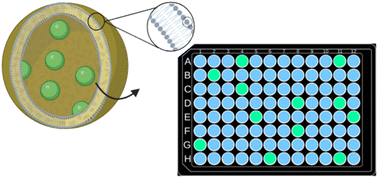
Small molecule ion transporters have shown promise as potential therapeutics for microbial infections, cancer and channelopathies. However, there are still gaps in our understanding of how ion transport function in model vesicle membranes translates to cell membranes of interest. The lipid composition of the membranes of bacterial and cancer cells differs markedly from normal human cells, yet the influence of the lipid composition on membrane function is rarely investigated – in part because of the low throughput and high cost of ion transport experiments. Here, we report an increased throughput Workflow to identify biologically relevant, pH-driven ion transport and membrane lysis pathways in vesicle membranes. We developed a set of four assays designed to report on different transport and lysis processes. We validated our assays against a panel of known transporters and produced a stepwise Workflow for the evaluation of libraries of compounds. We applied our Workflow to screen a library (Library 1) of 31 supramolecular, self-associating amphiphiles (SSAs) for transport and lysis activity in a range of vesicles with different lipid compositions, designed to mimic different types of cells, and consequently identified seven promising transporters. Antimicrobial experiments found that six of these promising transporters showed good antimicrobial activity against clinically relevant Staphylococcus aureus strains, highlighting the promise of our Workflow in identifying potential antimicrobial agents. We then applied our Workflow to investigate the ion transport and lysis properties of a second library (Library 2) of SSAs with established antimicrobial and anticancer properties, aiming to provide insight into the biological modes of action.
 Please wait while we load your content...


