Linear and branched supramolecular polymers formed from isomeric monomers as revealed by solution viscoelasticity

Abstract

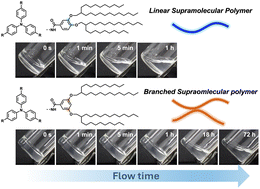
Supramolecular polymers (SPs) assembled through non-covalent interactions provide a promising platform for designing soft materials with dynamic and tunable properties. However, the viscoelastic properties of their solutions remain poorly understood, largely due to the tendency of SP chains to bundle into thick supramolecular fibers, often resulting in precipitation or gelation. In this study, we show that bundle formation can be effectively suppressed by appropriate design of the surface of SPs through alteration of their side chains. Structural analyses revealed that the resulting SPs are homogeneously solvated, permitting their rheological characterization. Notably, we found that even subtle modifications, such as positional isomerism of the side chains, can dramatically alter the physical properties of SP solutions. Our findings, therefore, highlight the critical role of side chains in governing hierarchical structures and macroscopic properties of SPs, offering a design strategy for engineering functional supramolecular materials.
Supplementary files

Transparent peer review

To support increased transparency, we offer authors the option to publish the peer review history alongside their article.

View this article’s peer review history

Article information

Article type
Edge Article
Submitted
12 Dec 2025
Accepted
13 Apr 2026
First published
14 Apr 2026
This article is Open Access

All publication charges for this article have been paid for by the Royal Society of Chemistry
Creative Commons BY-NC license

Chem. Sci., 2026, Accepted Manuscript

Linear and branched supramolecular polymers formed from isomeric monomers as revealed by solution viscoelasticity

Y. Furukawa, R. Sato, N. FUKAYA, T. Kajitani, T. Katashima and K. Sugiyasu, Chem. Sci., 2026, Accepted Manuscript , DOI: 10.1039/D5SC09763K

This article is licensed under a Creative Commons Attribution-NonCommercial 3.0 Unported Licence. You can use material from this article in other publications, without requesting further permission from the RSC, provided that the correct acknowledgement is given and it is not used for commercial purposes.

To request permission to reproduce material from this article in a commercial publication, please go to the Copyright Clearance Center request page.

If you are an author contributing to an RSC publication, you do not need to request permission provided correct acknowledgement is given.

If you are the author of this article, you do not need to request permission to reproduce figures and diagrams provided correct acknowledgement is given. If you want to reproduce the whole article in a third-party commercial publication (excluding your thesis/dissertation for which permission is not required) please go to the Copyright Clearance Center request page.

Read more about how to correctly acknowledge RSC content.

Social activity

Spotlight

Advertisements