Near-Infrared-to-Deep-Blue Photon Upconversion Engineered from PbS Quantum Dots and Perylene Derivatives

Abstract

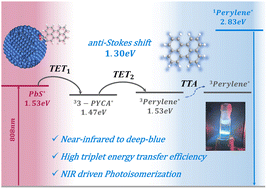
Near-infrared (NIR)-to-visible light triplet–triplet annihilation photon upconversion (TTA-UC) holds great promise for solar energy harvesting, photochemistry, and bioimaging. However, achieving a large apparent anti-Stokes shift from the NIR to the blue region remains highly challenging. Here, we present the first TTA-UC system that can upconvert NIR excitation beyond 800 nm with emission approaching the deep-blue spectral region. This performance is realized by precisely engineering the triplet energy levels within only 0.06 eV among PbS quantum dots (QDs) as sensitizers, perylene-3-carboxylic acid (3-PYCA) as a novel mediator and perylene as an annihilator. The system exhibits an exceptional anti-Stokes shift of up to 1.3 eV, representing both a record performance to date and the maximum for QD-based TTA-UC systems. Meanwhile, a high TTA-UC quantum yield of 2.1% (out of a 50% maximum) is achieved, which is an order of magnitude higher than previously reported QD-based systems exhibiting anti-Stokes shifts above 0.8 eV. Moreover, the upconverted deep-blue light enables efficiently activated cis-to-trans photoisomerization of azobenzene (Azo), demonstrating the high potential in NIR light triggered photochemical transformation.
Supplementary files

Transparent peer review

To support increased transparency, we offer authors the option to publish the peer review history alongside their article.

View this article’s peer review history

Article information

Article type
Edge Article
Submitted
12 Dec 2025
Accepted
16 Feb 2026
First published
18 Feb 2026
This article is Open Access

All publication charges for this article have been paid for by the Royal Society of Chemistry
Creative Commons BY-NC license

Chem. Sci., 2026, Accepted Manuscript

Near-Infrared-to-Deep-Blue Photon Upconversion Engineered from PbS Quantum Dots and Perylene Derivatives

H. Li, Q. Luan, S. Zhang, L. Xi, Y. Feng and L. Hou, Chem. Sci., 2026, Accepted Manuscript , DOI: 10.1039/D5SC09759B

This article is licensed under a Creative Commons Attribution-NonCommercial 3.0 Unported Licence. You can use material from this article in other publications, without requesting further permission from the RSC, provided that the correct acknowledgement is given and it is not used for commercial purposes.

To request permission to reproduce material from this article in a commercial publication, please go to the Copyright Clearance Center request page.

If you are an author contributing to an RSC publication, you do not need to request permission provided correct acknowledgement is given.

If you are the author of this article, you do not need to request permission to reproduce figures and diagrams provided correct acknowledgement is given. If you want to reproduce the whole article in a third-party commercial publication (excluding your thesis/dissertation for which permission is not required) please go to the Copyright Clearance Center request page.

Read more about how to correctly acknowledge RSC content.

Social activity

Spotlight

Advertisements