Selenol-containing two-dimensional perovskite promotes visible-light-driven selective reduction of unsaturated ketones

Abstract

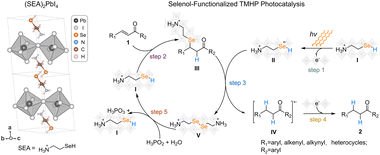
Semiconductors have shown growing promise for photocatalytic reactions due to their tunable band structures and efficient charge separation capabilities. Among them, metal halide perovskites (MHPs) have emerged as particularly attractive candidates owing to their intense light absorption and favorable charge transport properties, yet the inefficient charge utilization often occurs on MHP-based photocatalysis due to undesired interfacial charge losses and lattice mismatches within the heterostructures. Here, we report a two-dimensional perovskite (TMHP) photocatalyst, where selenol-functionalized organic cations are integrated into the lattice as both structural components and catalytic sites. This design enables efficient photoinduced charge separation and transfer from the [PbI4]2- layers to the selenol groups, achieving visible-light-driven reduction of α,β-unsaturated ketones with up to 87% yield across diverse substrates. Mechanistic studies reveal a radical-mediated pathway facilitated by the polarized lattice environment. This work demonstrates a new strategy for engineering molecular functionality into semiconductor lattices, and creating integrated, efficient photocatalytic systems.
Supplementary files

Article information

Article type
Edge Article
Submitted
10 Dec 2025
Accepted
08 Mar 2026
First published
10 Mar 2026
This article is Open Access

All publication charges for this article have been paid for by the Royal Society of Chemistry
Creative Commons BY-NC license

Chem. Sci., 2026, Accepted Manuscript

Selenol-containing two-dimensional perovskite promotes visible-light-driven selective reduction of unsaturated ketones

W. Li, L. Liao, G. Yao, J. Liu, Y. Zhang, J. Li, W. Qiu, T. Zeng, X. Zhao and Z. Yang, Chem. Sci., 2026, Accepted Manuscript , DOI: 10.1039/D5SC09706A

This article is licensed under a Creative Commons Attribution-NonCommercial 3.0 Unported Licence. You can use material from this article in other publications, without requesting further permission from the RSC, provided that the correct acknowledgement is given and it is not used for commercial purposes.

To request permission to reproduce material from this article in a commercial publication, please go to the Copyright Clearance Center request page.

If you are an author contributing to an RSC publication, you do not need to request permission provided correct acknowledgement is given.

If you are the author of this article, you do not need to request permission to reproduce figures and diagrams provided correct acknowledgement is given. If you want to reproduce the whole article in a third-party commercial publication (excluding your thesis/dissertation for which permission is not required) please go to the Copyright Clearance Center request page.

Read more about how to correctly acknowledge RSC content.

Social activity

Spotlight

Advertisements