


 PLATFORM UPDATE:


Screening pertactin-specific antibodies and evaluating competitive epitope recognition by native mass spectrometry

Abstract
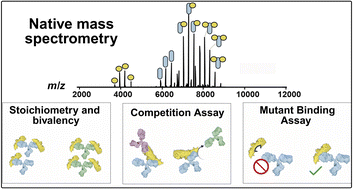
Structural characterization of antigen–antibody interactions is critical for understanding protective vaccine responses and development of therapeutic monoclonal antibodies (mAb). Traditional biophysical and biochemical techniques often require the immobilization of one binding partner or provide ensemble-averaged measurements, constraints which may limit the ability to probe multiple facets of antigen–antibody interactions. Native mass spectrometry (nMS) offers a versatile alternative, providing a comprehensive view of antigen–antibody complexes. Here, we utilized native MS to screen the interactions between a small panel of monoclonal antibodies (mAbs) and the Bordetella pertussis vaccine antigen mature pertactin (Prn), offering in-depth characterization of binding affinity, stoichiometry, and competition. We implemented variable temperature electrospray ionization to evaluate thermally induced unfolding and stability of different mAb·Prn complexes, while biolayer interferometry (BLI) and competition experiments were employed to provide complementary information about binding kinetics and mapping of distinct epitopes on Prn. Finally, we used nMS to evaluate the interactions of individual mAbs with Prn variants as a predictor for therapeutic action. Our results demonstrate the utility of nMS in combination with other techniques as a powerful approach for understanding the interactions of protective mAb binding to Prn, providing insight into mechanisms of vaccine-induced protection.
 Please wait while we load your content...


