


 PLATFORM UPDATE:

The critical role of isolated Ti3+ sites in MIL-125 for photocatalytic nitrate reduction: performance enhancement and deactivation mechanism
 *ac
Xuepeng
Wang,
b
*ac
Xuepeng
Wang,
b
Abstract
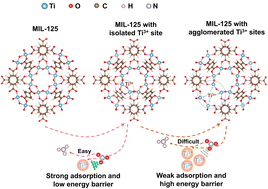
Photocatalytic reduction of nitrate (NO3−) to ammonia (NH3) represents a sustainable route for wastewater treatment and chemical production. Metal–organic frameworks (MOFs) such as MIL-125 are promising catalysts, yet their performance often decays during reaction. This study reveals that the aggregation state of Ti3+ sites in MIL-125 is a critical factor governing its photocatalytic efficiency. We demonstrate that the as-synthesized MIL-125, featuring isolated Ti3+ sites, achieves a high NH3 production rate of 738.32 µmol g−1 h−1 under full-spectrum light without sacrificial agents. Comprehensive characterization and theoretical calculations indicate that these isolated Ti3+ sites elevate the material's conduction band and enhance NO3− adsorption, thereby lowering the energy barrier for the rate-determining step. However, prolonged photoreaction leads to linker deficiency, resulting in agglomeration of Ti3+ sites. This structural evolution causes a negative shift in the conduction band potential, impedes charge separation, and increases the reaction barrier, leading to a noticeable loss in activity over cycles. This work underscores the pivotal role of maintaining isolated metal sites for designing stable and efficient MOF-based photocatalysts for nitrogen cycling.
 Please wait while we load your content...


